
There’s a particular kind of frustration that only frequent travellers know. It’s the one that arrives when the ride-hailing app announces a surge price at 5:47am. When the taxi rank outside Heathrow Terminal 5 has a 40-minute queue after a long-haul flight. When you’re trying to prepare mentally for a high-stakes board meeting in the back seat of a vehicle that smells of someone else’s evening and has a cracked phone charger dangling uselessly from the dashboard.
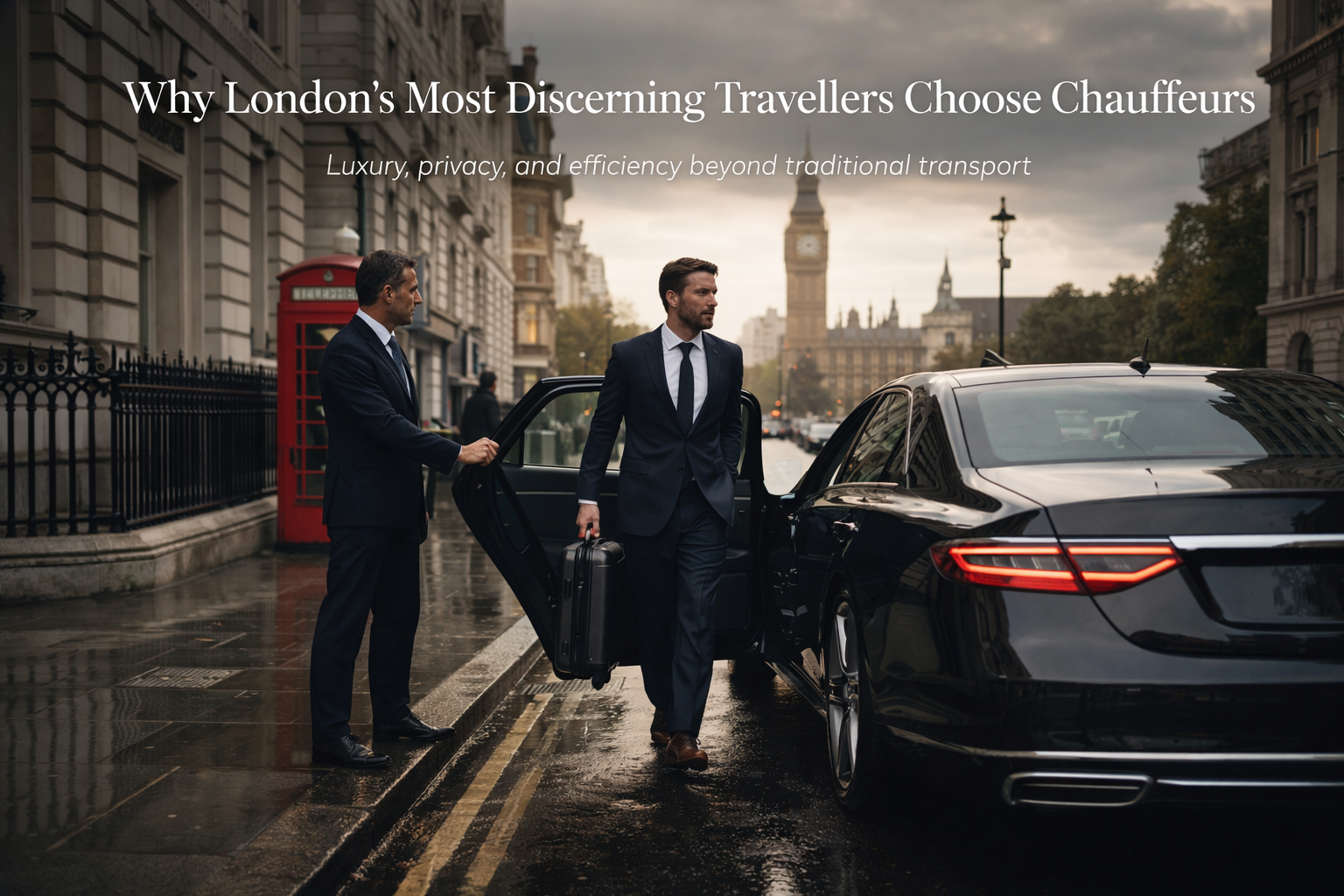
London is one of the world’s great cities for so many reasons. For ground transport at the level that matches the rest of a first-class life, it has historically required either luck, advance planning, or knowing exactly the right provider.
That equation has shifted. The global chauffeur car market was valued at $20.6 billion in 2024 and is projected to reach $35 billion by 2035 — growing at a compound annual rate of 4.9%. This isn’t growth driven by novelty. It’s growth driven by a category of traveller — business professionals, high-net-worth individuals, international visitors, families with high standards — who have tried the alternatives and concluded, definitively, that premium chauffeur-driven travel isn’t an upgrade. It’s the baseline.
What a Concierge Chauffeur Service Actually Delivers — Versus What Most People Assume
The word “chauffeur” still carries associations for some people: white gloves, vintage cars, the exclusive province of royalty or pop stars. That image bears almost no relationship to what a modern luxury concierge chauffeur operation in London actually delivers in 2025.
What it actually delivers is this: a professionally trained, fully licensed driver in an immaculately maintained premium vehicle — typically a Mercedes-Benz S-Class, V-Class, Range Rover, or equivalent — who arrives before you’re expecting them, manages every logistical detail of your journey without being asked, and gets you to your destination in precisely the condition you want to be in when you arrive. No stress, no delays, no explanations required.
The concierge dimension extends beyond the vehicle. , event and occasion chauffeurs, corporate roadshow logistics, hourly and full-day hire, and self-drive fleet access for clients who want the vehicle rather than the driver. That breadth is deliberate — because the clients who use genuine luxury concierge services don’t compartmentalise their travel needs into separate categories. They want a single trusted provider who understands their standards and applies them consistently.
The Airport Transfer That Sets the Tone for Everything That Follows
Ask anyone who has experienced both ends of the airport transfer spectrum — budget option and genuine luxury chauffeur — and they will tell you that the difference isn’t just comfort. It’s psychological. The tone of a journey is established in the first ten minutes, and the first ten minutes of a business trip or a leisure break begin when you step out of arrivals.
London handles more international air traffic than almost any city on earth. Heathrow handles over 80 million passengers annually. Gatwick, Stansted, Luton, London City, and the private aviation terminals at Farnborough, Biggin Hill, and London Oxford add millions more. The default chaos of navigating that system — queues, delays, luggage carousels, taxi ranks, surge pricing — is a choice, not a necessity. A pre-booked luxury chauffeur transfer converts that chaos into something entirely different.
The major London airports typically sit 45 to 90 minutes from central London by road, depending on traffic. That’s 45 to 90 minutes that a corporate executive might use to review briefing materials, take calls, or decompress after a transatlantic flight. In a black cab queued on the motorway, none of that is possible. In the back of a properly equipped luxury chauffeur vehicle — Wi-Fi, privacy glass, quiet cabin, phone charging — all of it is.
The Corporate Client Who Has Calculated the Real Cost of Cheap Ground Transport
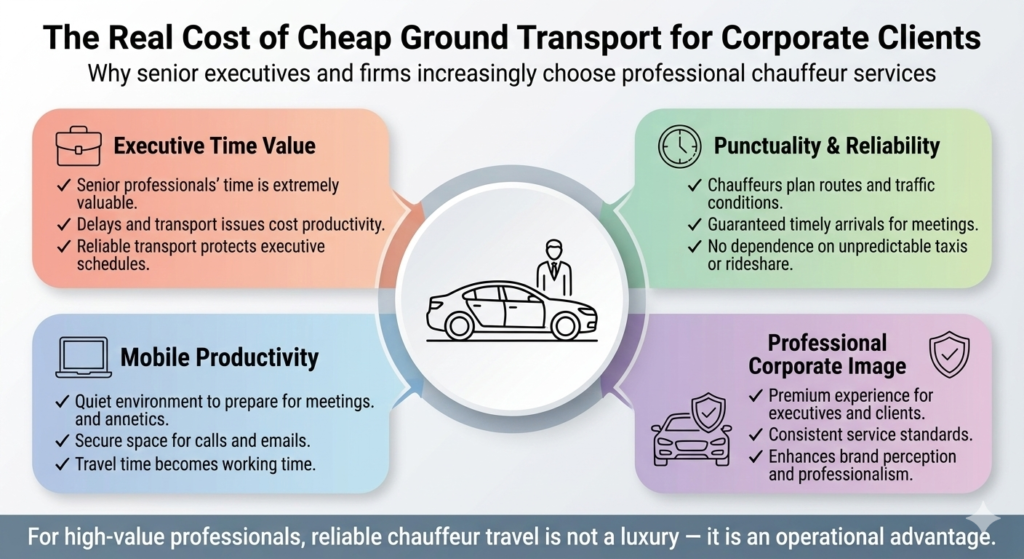
There’s a business case for luxury chauffeur services that gets made implicitly every time a senior executive shows up to a meeting looking harried, late, and under-prepared. The explicit version runs something like this.
A partner at a law firm or investment bank in London earns, at minimum, several hundred pounds an hour in billable time. The difference in cost between a reliable luxury chauffeur and an unreliable alternative might be £40 to £80 per journey. The difference in productive use of that journey time — or the cost of arriving at a client meeting not in the state you’d choose — is orders of magnitude larger. The maths isn’t complicated.
Corporate chauffeur accounts for a significant and growing segment of the premium transport market, precisely because firms and individual professionals have done that calculation. The segment of the chauffeur market dedicated to corporate travel is projected to reach $10.5 billion globally by 2035, driven by exactly this logic: that for the people whose time and presentation matter most, the transport infrastructure supporting those outcomes needs to match the standard of everything else.
The London concierge chauffeur model serves this logic well. An hourly chauffeur engagement means no parking, no congestion charge complications, no inter-meeting dead time wasted on logistics. A professional driver who manages route optimisation in real time, handles the vehicle while the client handles their schedule, and maintains the discretion that complex professional engagements often require — that’s not a luxury in the hospitality sense. It’s a functional component of how serious professionals operate in a serious city.
Occasions That Deserve Transport to Match
Not every journey is a business transfer. Some journeys are the thing itself — the arrival at a wedding where the car is part of the moment, the departure after a marriage proposal, the sixtieth birthday celebrated with an evening in the city, the private event at a venue where the entrance matters.
London’s calendar of occasions is relentless. The social season, sporting events at Ascot and Wimbledon, opera nights, gallery openings, restaurant anniversaries, corporate hospitality, milestone celebrations of every kind — the city generates reasons to arrive in style at a rate that no other European capital matches. The private hire and taxi sector in England recorded 381,100 combined driver licences as of April 2024, a 10% year-on-year increase. But the growth within that number is concentrated in premium private hire, where clients have moved away from standard options toward providers who can match the occasion.
What makes a chauffeur appropriate for an occasion isn’t the vehicle alone, though a Rolls-Royce, Bentley Mulsanne, or Range Rover Autobiography does communicate something clear about the event’s register. It’s the choreography: the timing that ensures arrival precisely when required, the presentation of the driver, the management of the door, the handling of guests, the understanding of where to wait and when to return. Occasion chauffeurs who do this well are not simply drivers — they are a functioning component of how a special event unfolds, and their professionalism either elevates the occasion or quietly detracts from it.
The Rise of the Music, Sports, and Entertainment Sector in Premium Ground Transport
Beyond the corporate and occasion markets, London’s entertainment and sports infrastructure generates a category of chauffeur demand that operates at high volume, high complexity, and high stakes. Touring musicians, sports teams, athletes, visiting international celebrities, production crews, and the extended networks of VIP guests who surround major events all require ground transport that is simultaneously seamless, discreet, and capable of scaling to unusual logistics.
A concert tour with multiple artists and extensive crew requires vehicles coordinated across multiple simultaneous movements. A sports team arriving for a high-profile fixture requires transport that manages crowd exposure, timing precision, and the kind of privacy that allows focus before performance. An artist appearing on a television broadcast or at a media event requires a vehicle waiting in exactly the right place at exactly the right time, not circling the block.
These requirements have driven specialist capability in the premium concierge chauffeur sector — expertise in multi-vehicle coordination, entertainment industry scheduling, media scrums, and the specific protocols that high-profile individuals and their teams require. The London operators who work regularly in this space develop institutional knowledge about how the industry operates that general hire companies simply don’t possess.
Understanding What Separates a True Luxury Concierge Experience from a Dressed-Up Standard One
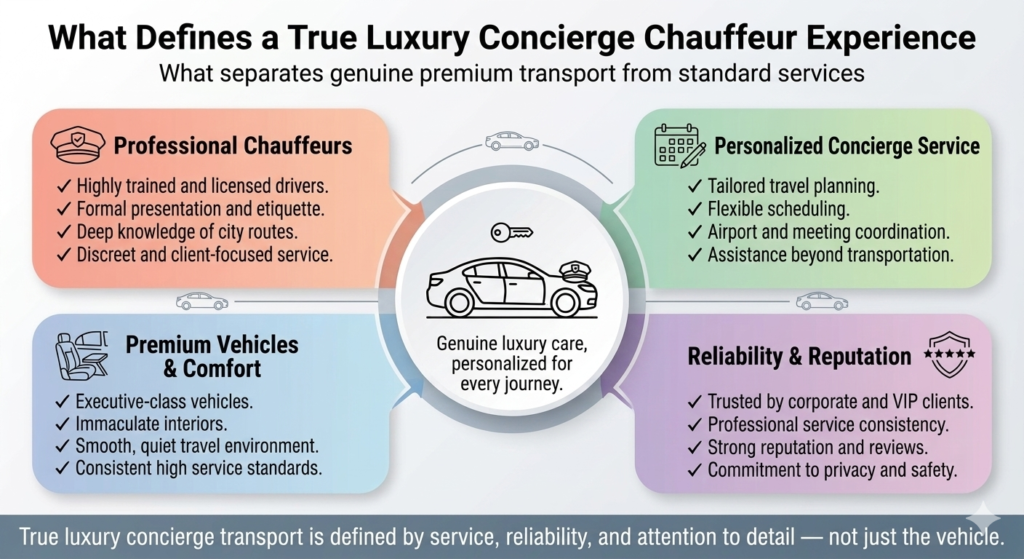
The luxury concierge chauffeur market has grown substantially enough that the term “luxury” is now applied to a very wide range of offerings. Understanding what genuine luxury concierge transportation actually consists of, versus a standard service with a premium price, matters for anyone making a serious choice about who to trust with their ground transport.
The vehicle standard is the first differentiator but not the most important one. Premium fleet vehicles — Mercedes S-Class and V-Class, Range Rover, Bentley, Rolls-Royce — are table stakes for the genuine luxury segment. Immaculate condition, regular deep cleaning, full mechanical service history, and the specific interior appointments that make long journeys comfortable (working Wi-Fi, phone charging at every seat, bottled still water, climate calibration) separate the operators who take the fleet seriously from those who use the right badges without the follow-through.
Chauffeur professionalism is the more significant differentiator. The best London chauffeurs combine deep knowledge of the city’s geography (including which routes actually work at which times, not just what the navigation suggests), PCO licensing and compliance, first-aid training, and the particular interpersonal calibration that luxury service requires. Some clients want conversation; some want complete privacy and silence. Some have security sensitivities; some have accessibility requirements. Reading those cues correctly, maintaining appropriate discretion, and never requiring a client to manage the communication dynamic — that’s the human dimension of premium chauffeur service, and it’s what review after review of the best London operators cites as the decisive factor.
Operational reliability at the backend is the third leg. A luxury service that cannot consistently guarantee vehicle availability, that responds to last-minute changes with friction rather than flexibility, or that handles exceptions and complications with anything less than total competence, is not genuinely operating at the luxury level regardless of how the marketing presents it. The operational infrastructure — booking systems, dispatch coordination, real-time communication, the ability to cover a vehicle that has an issue with an equivalent substitute in a matter of minutes — is invisible when it works and catastrophic when it doesn’t.
London as a City That Rewards Those Who Move Through It Well
There’s a version of London that tourists experience and a version that residents and regular visitors come to inhabit. They share the same geography but occupy it entirely differently. The tourist version involves the Underground at rush hour, black cabs on a Friday evening at a flat fare that seemed fine until the traffic didn’t move for twenty minutes, and the vague anxiety of being in a large foreign city with imperfect information about how it works.
The resident and sophisticated visitor version involves knowing which neighbourhoods connect to which by car in what time, understanding the congestion charge zone and how it affects routing, having a ground transport arrangement that reliably handles the distance between a meeting in the City and a dinner in Mayfair in the forty-five minutes between them, and never thinking twice about how you’re getting to the airport in the morning.
The UK’s private hire sector grew at a CAGR of 6.3% between 2020 and 2025, and passenger expectations across that period shifted in one consistent direction: real-time driver tracking, fixed transparent pricing with no surge mechanics, digital receipts for expenses, and multi-language support for London’s international visitor population. The operators who have kept pace with those expectations have built reliable repeat client bases; those who haven’t have been filtered out by an increasingly sophisticated market.
The Preparation That Makes a Premium Journey Possible
A significant amount of what makes a luxury chauffeur experience work happens before the client ever enters the vehicle. The booking process — clear, fast, confirmation arriving promptly, all relevant details captured accurately — signals from the first interaction whether the operational standard will hold. A client booking a Heathrow pick-up at 3am after a long-haul flight is, in part, trusting that confirmation. The anxiety of not being certain is the opposite of what luxury transport is supposed to deliver.
Research-phase planning for high-value travel often involves registering across multiple provider platforms and hospitality systems simultaneously — hotel concierge services, private club memberships, aviation operators, and ground transport providers — all of which generate confirmations and communications that can overwhelm a primary inbox. Sophisticated travellers managing this research phase often use a dedicated email address for platform registrations and vendor communications during the comparison and booking phase.. Keeping the research phase contained like that is the kind of small logistical discipline that high-functioning travellers practice consistently.
The Standard London Deserves — And What It Looks Like in Practice
London is ranked consistently among the world’s top five cities for business, culture, and luxury travel. The Britons alone take approximately 4.2 million luxury trips annually, spending an average of £7,200 per trip. By 2030, that figure is expected to rise to 5.3 million trips, with average trip spending approaching £8,500. International visitors add to those numbers considerably — and their expectations, shaped by premium travel experiences in other world cities, are not modest.
Against that backdrop, the standard for luxury ground transport in London isn’t an abstraction. It’s a Rolls-Royce Ghost or a Mercedes S-Class arriving two minutes early. It’s a chauffeur who greets you by name and has already confirmed your destination and preferences from the booking notes. It’s a journey through the city conducted in genuine comfort and quiet, with the logistics entirely handled, arriving at your destination in the condition that the rest of your day requires.
When the standard of everything else in your London experience is set at the highest level, the car that carries you through it should be too. That’s not aspiration — it’s coherence.